The definition: what does dunning mean?
Dunning is the process of communicating with customers after a payment has failed in order to recover the revenue before the subscription lapses. The word comes from 17th-century debt collection — a "dun" was a persistent creditor — but in modern SaaS it refers to the automated sequence of retries, emails, and payment update prompts triggered after a card declines.
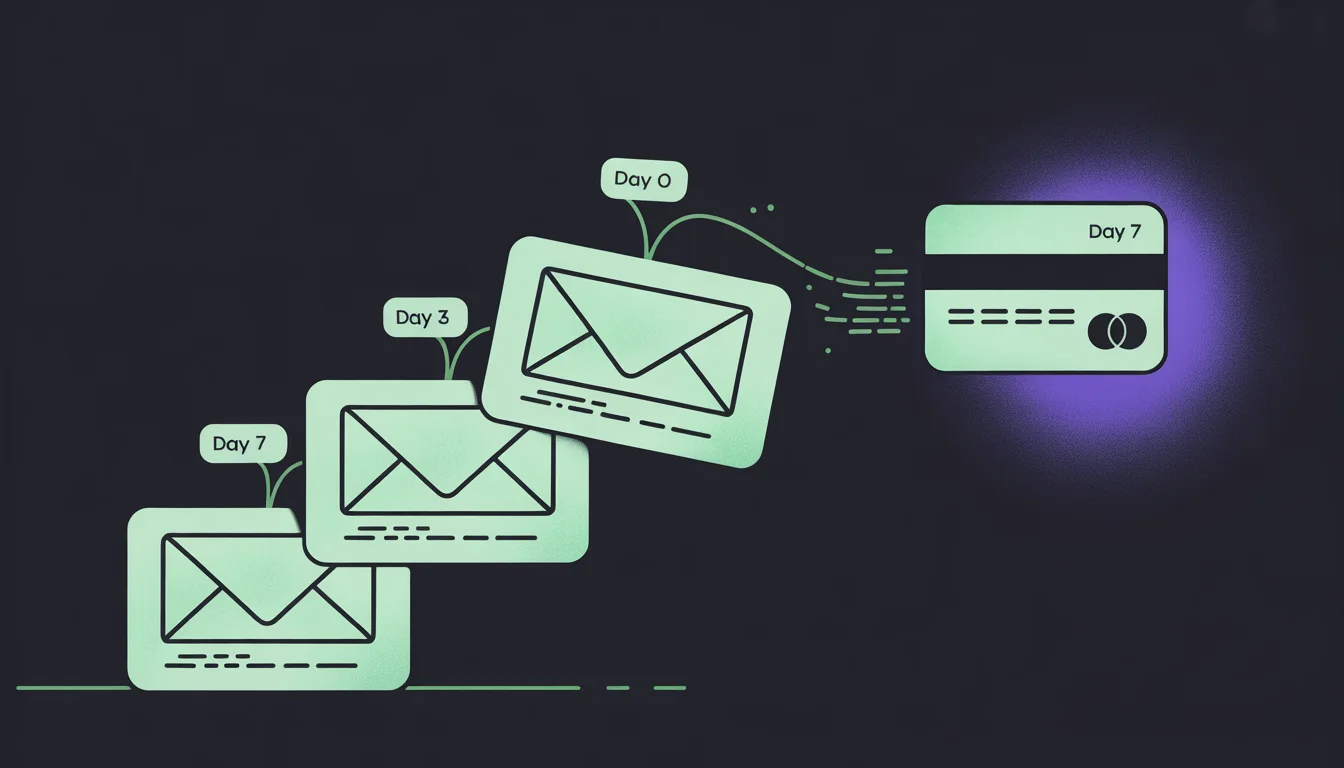
In practice: a subscriber's card fails on their renewal date. Instead of immediately cancelling, your billing system triggers a recovery sequence — an email notifying the customer, a smart retry of the card two days later, a follow-up reminder, a final warning before cancellation — until the payment succeeds or the grace period expires.
Done well, dunning is invisible to happy customers whose retry succeeds silently. For customers with genuinely failing cards, it creates a clear, low-friction path to fix the issue without losing access.
Why do subscription payments fail?
Most failed payments are not intentional — the customer didn't decide to cancel. Common causes:
Expired card
The card on file has passed its expiration date. This is the most recoverable failure — the customer likely has a new card and just hasn't updated it.
Insufficient funds
A temporary balance issue, often at month-end or with debit cards. Smart retries at a different time of month recover a significant share of these.
Bank fraud flag
The issuing bank flagged the renewal as suspicious. Increasingly common as bank fraud models tighten — even expected charges get caught.
Card reported lost or stolen
The subscriber has a new card but hasn't updated the subscription. An email with a direct update link resolves these quickly.
Hard decline / closed account
The account is closed or the card number is no longer valid. These are generally unrecoverable without customer action.
Network / gateway error
A transient processing error. These often succeed immediately on the first smart retry with no email required.
Involuntary churn: the metric dunning fights
Subscription churn splits into two types:
- 1.Voluntary churn — a customer cancels because they no longer want the product. This requires product work, pricing work, and retention tooling (cancel flows, exit surveys) to address.
- 2.Involuntary churn — a subscription lapses due to payment failure, not a deliberate customer decision. This is the category dunning attacks — and it's almost entirely recoverable.
Industry data consistently puts involuntary churn at 20–40% of all subscription cancellations. That means for every 10 subscriptions you lose in a month, 2–4 could have been saved with a working dunning system.
The compounding math is brutal. At $50/mo average contract value with 200 subscribers, a 2% involuntary churn rate is $200/mo in preventable MRR loss — $2,400/year. With a proper dunning sequence recovering 50% of those failures, you're saving $1,200/year for a tool that costs $29–89/month.
What a dunning sequence looks like
A best-practice dunning sequence for Stripe SaaS runs 14–21 days from the initial failure:
Smart retry + immediate notification
Stripe fires a smart retry for soft declines (insufficient funds, network errors). An email goes out immediately to the customer explaining the failure and linking to a payment update page.
Second retry + first reminder
Another retry attempt timed to the optimal window. If it fails, a reminder email goes out — friendly, no urgency yet, focused on helping the customer fix the issue.
Urgent reminder + backup payment request
Tone shifts. The email makes clear that access may be suspended soon. A backup payment method request asks the customer to add an alternative card.
Final warning before suspension
Last chance email. Direct subject line, one clear CTA, countdown language. Some tools also send an in-app notification at this stage.
Subscription cancelled
If payment hasn't been recovered, the subscription lapses. A win-back email sequence begins — designed to re-engage the customer if they return or if the payment issue was a temporary mistake.
Dunning vs. smart retries: what's the difference?
These two terms appear together constantly but describe different layers of the recovery system:
Smart retries are the automated attempts to re-charge the card using decline reason codes to pick the optimal retry window. A naive retry system fires at fixed intervals. A smart system knows that "insufficient funds" (NSF) should be retried mid-month when the customer is likely to have been paid; "do not honour" should trigger an email immediately rather than another charge attempt.
Dunning is the full system: emails, hosted payment update pages, backup card capture, grace period logic, and win-back campaigns. Think of retries as the automated background layer and dunning as the user-facing communication layer wrapped around it. Good recovery software handles both.
Stripe's native dunning vs. dedicated dunning software
Stripe includes a basic dunning system: Smart Retries and one configurable email. For the first $2,000–3,000 MRR, this is often sufficient.
What Stripe's built-in system lacks:
- —Multi-step email sequences (Stripe sends one email; a dunning tool sends a timed sequence over 14–21 days)
- —Custom email branding (Stripe emails look like Stripe)
- —Hosted payment update pages with backup card capture
- —Win-back campaigns for subscriptions that do lapse
- —Recovery analytics (which failure reasons? which email drove the update?)
- —Cancel flow intervention — stopping intentional cancellations before they happen
- —Fraud alerts and dispute rate monitoring
Dedicated tools like MRRescue, Churnkey, or Stunning add the full sequence on top of Stripe. Once you're past ~$3,000 MRR, the tool cost is typically recovered within 30–60 days.
See exactly how much you're losing to failed payments
Connect Stripe in 5 minutes. Free 14-day diagnosis — no credit card required.
Run free diagnosis →How much MRR can dunning recover?
Recovery rates vary by average contract value, email deliverability, and sequence sophistication. General benchmarks from across the industry:
of failed payments recover on the first smart retry alone — before any email is sent.
of failed payments are recoverable with a full dunning sequence (emails + retries + backup card capture).
of total recoveries come specifically from backup payment method capture — customers adding an alternative card.
of MRR is lost on average across Stripe SaaS businesses with no dunning system in place.
At $15,000 MRR, recovering an extra 1.5% per month through dunning is $225/month — $2,700/year — on a tool that costs under $100/month. The ROI math almost always works in favour of setting this up early.
Continue learning
6 Failed Payment Email Templates for Stripe SaaS
Copy-paste dunning emails with subject lines and timing guidance
How to Reduce Involuntary Churn: The Complete Guide
The full playbook for stopping payment-related subscription loss
MRRescue: Failed Payment Recovery
How MRRescue's automated recovery works for Stripe
MRRescue: Smart Payment Retries
Retry logic built on top of Stripe's native system
Stripe Decline Codes Explained
Every decline code with retry strategy and email copy
Frequently asked questions
What is dunning in SaaS?
Dunning in SaaS is the automated process of following up with customers after a subscription payment fails. It typically involves smart payment retries and a multi-step email sequence sent over 7–21 days to recover the subscription before it lapses.
Why do subscription payments fail?
Subscription payments fail most commonly due to expired cards (25–30% of declines), insufficient funds, bank-side fraud flags, network errors, or cards reported lost or stolen. Studies show that 20–40% of subscription cancellations are involuntary — caused by payment failure, not by customer intent.
What is a dunning email?
A dunning email is a transactional notification sent to a subscriber after their payment has failed. It explains that payment couldn't be processed, asks the subscriber to update their payment method, and includes a direct link to a hosted payment update page.
How long should a dunning sequence last?
Most effective dunning sequences run 7–21 days. A common pattern: immediate notification on day 0, first reminder on day 3, urgent warning on day 7, and a final notice before cancellation on day 14. Longer sequences can recover marginally more revenue but risk irritating customers.
What's the difference between dunning and smart retries?
Smart retries are the automated attempts to re-charge a card after a failure, using decline reason codes to pick the best retry time. Dunning is the broader process: the email communication, payment update flows, and cancellation logic built around those retries. Good dunning software handles both layers.
Do I need dunning software or can Stripe handle it?
Stripe includes basic dunning — Smart Retries plus one configurable email. For very early-stage companies this is often enough. But Stripe's native system lacks a multi-step email sequence, custom branding, backup payment method capture, win-back campaigns, and recovery analytics. Dedicated dunning tools layer all of this on top of Stripe.
Stop losing MRR to failed payments
MRRescue automates your full dunning sequence on top of Stripe. Connect in 5 minutes, free 14-day trial — no credit card required.
Start free →